Can writers ever be considered ‘good’ people? And what would our characters say to us if they had the chance?
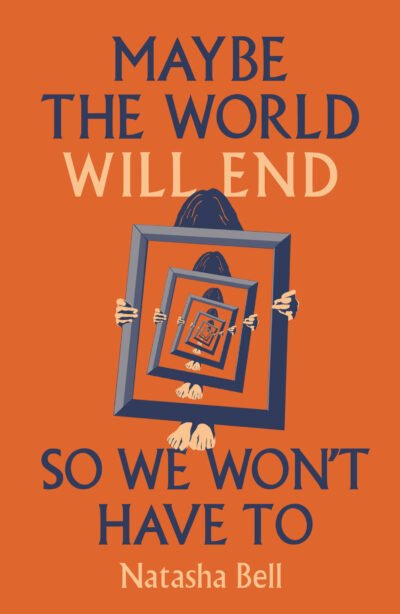
Coming 1st September 2026
Author Harry is divorced, depressed, out of contract and unsure what she wants to do with the rest of her life. She invents a character Natalie – a braver, bolder version of herself – whom she begins channelling in small ways in her own life.
A metafictional tour de force, Maybe the World Will End So We Won’t Have To is a finely crafted literary autofiction about identity, sexuality and the work that goes into writing a novel. Brilliantly queer and feminist, and by turns funny and dark, it leaves us questioning the practice and ethics of being a writer.
Early Praise
“a fantastic, mysteriously dark and funny, literary page-turner which adds a piercingly true queer perspective to the world of autofiction. Bell’s novel twists and turns, wriggling along, shifting us into new perspectives about what it is to use persona and indeed construct a narrative. It acts as a fierce siren, firing off questions to those of us who write and read autobiographical writing - can we resist doing it? How far do we go and at what cost? I loved it. ”
“A fall into the metafictional abyss has never been so funny, or so absurdly inventive, or so pointed about the alternating egotisms and humiliations of the writing life.”
“dazzlingly intelligent, searching out the core of truth within the mess of self and self-narration. It is fearlessly honest, emotionally acute and very funny. I loved it.”
“a darkly funny novel about writing, love, and the messiness of self. The book constantly asks whose story is it and at what price can it be told. As playful as it is emotionally devastating, Natasha Bell expertly navigates a story where the boundaries between author and character have collapsed.”
“a deep dive into the ethics of writing about “real life”. Bell transforms herself into a character named Harry who transforms herself into a character named Natalie – and by page thirty-two we’re deep inside a narrative fun house. The literary shenanigans include scenes in which Bell’s impatient alter-ego (who proves herself to be a savvy armchair psychologist, a sharp literary critic, and a pretty good pugilist) confronts her creator. But all the while, real life pulses beneath – and through – this beautiful make-believe world of words. In the end, neither the story nor the life it attempts to represent can lay claim to the last word. That honour belongs to something far more human: the messy entanglement of the two.”
“ a finely crafted, exploration of love, identity, sexuality and the process of storytelling. Playful, honest and darkly funny this novel skilfully weaves observations about what it really means to be a writer with a compelling and surprising plot, the result is pure metafictional joy.”
“Natasha Bell tests how far reality can bend with total control. This is a mesmerising, fiercely intelligent book. I loved it.”
“It seems the autofictional novel to end all autofictional novels has just been written, so we won’t have to. Reading Natasha Bell’s Maybe the World Will End So We Won’t Have To’s structural and allusive prowess, might make us feel this is so. But these nosy, juicy, highbrow, and guilt-ridden sentences beckon us further and further into the mise en abyme of reading witnessing of writing reading. Each layer is a perfect balance of raucously fun and archly disturbing.”
“Quite an achievement. Some images will stay with me a long time. Thoroughly examines that border between privacy and exposure, between intimacy and betrayal, and captures the internal thoughts of writers so well. Always thinking of potential storylines, always thinking about plot, always trying to link images to action, to think of twists and reversals and killer lines. The pages turn themselves…”
“This magnificent book, which is part auto-fiction and part metafiction, is a stunning exploration of what it means to be a writer, to not only contain multitudes (thank you Walt Whitman) but to create and destroy them at will. Whether you’re a writer, or a reader, or both, it’s a unique and absorbing meditation on the difference, if any, between life and art. I loved it.”
“With Maybe the World Will End So We Won’t Have To, Natasha Bell has done something extraordinary – an irreverent play on the madness and magic of spinning stories, as well as the enduring need to make sense of our surroundings and that nebulous thing we call ‘identity’, through writing. Bell captures this process in its excruciating and transcendent complexity. I found the book playful, surprising and moving. Its lessons and provocations will remain with me.”
“skilfully captures the liminal space between writing and dreaming, and the intense juxtaposition between the godlike complex and intense helplessness of being a writer, all while maintaining a growing sense of impending doom as the main character writes herself into a mess. Interesting, provocative and darkly funny at times!”